Block vs Poured Foundations: What Changes When You Cut
Two houses, both Calgary, both with a basement bedroom that needs a window. One has a poured concrete foundation and one has a concrete block foundation.
Same code requirements. Same window. Substantially different job.
The structural difference in one idea
A poured wall is a single continuous object. Concrete was placed into forms and set as one piece, usually with reinforcement in it. When you cut a hole, the material around the hole is still the same object, and it behaves the way a continuous element behaves — including, often, redistributing load around the opening.
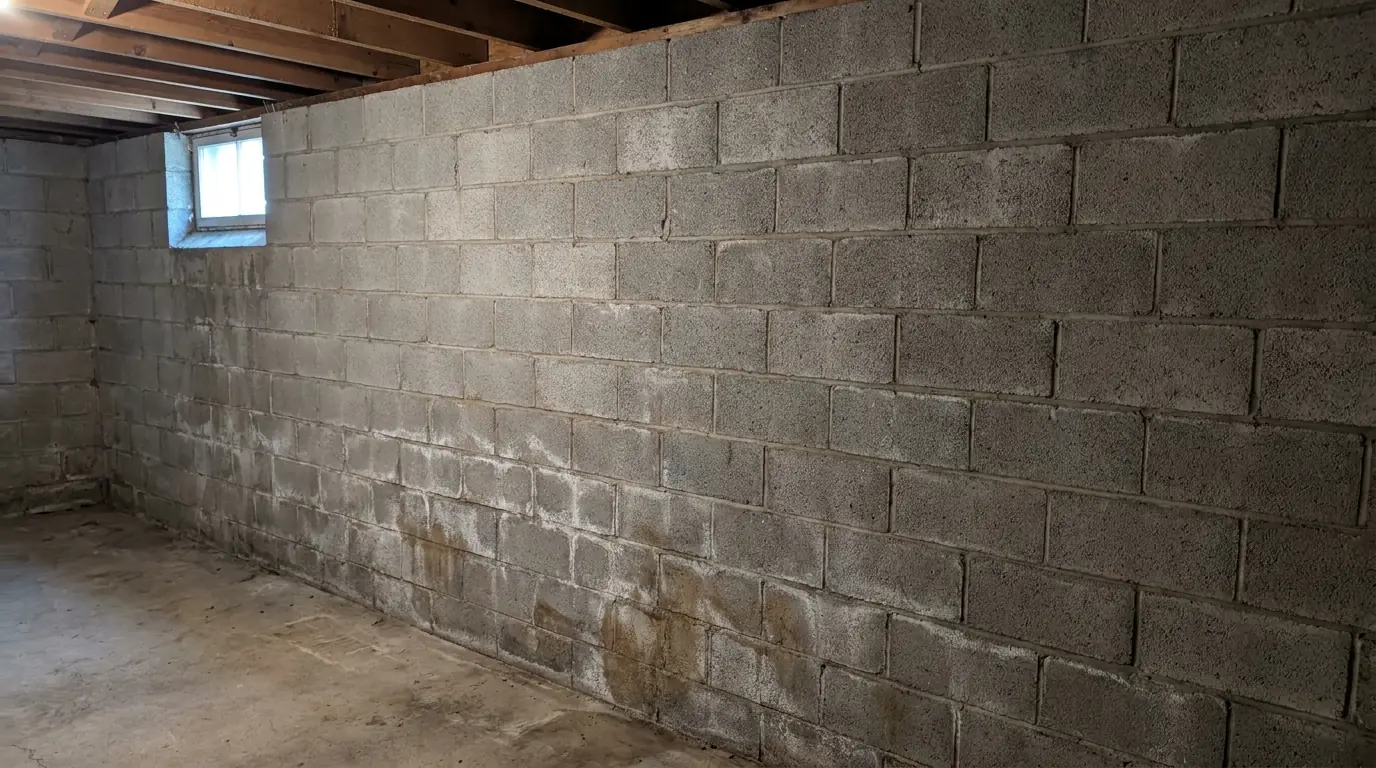
A block wall is a stack. Individual units, hollow cores, mortar joints between them. It is extremely capable in compression, which is what a foundation wall mostly does. It is much less capable of the other things, and the joints are where its behaviour is decided.
Cut a hole in a stack and you have interrupted the load path of every course above the opening at once, with nothing continuous to carry it sideways unless somebody put it there. Whether load will arch over the opening — which is the mechanism that makes a modest opening in a poured wall relatively benign — is much less certain, because arching wants continuity and a block wall’s continuity depends on details that are invisible from either face.
That is the whole difference, and everything below is a consequence of it.
What changes in practice
Temporary support becomes more likely. In a poured wall, the sequence is frequently to set the lintel and let it take the load before the material below comes out. In a block wall, the engineer is more likely to want the load carried independently — shoring or needling — while the opening is made and the permanent lintel installed. More equipment, more time, more sequencing.
Bearing needs preparing. A lintel has to land on something solid at each end. Landing it on hollow cores is not that. Filling cores at the bearing zones is a common answer, and where and how much is the engineer’s call, not a rule of thumb.
The wall’s actual condition matters more. Mortar joints deteriorate. Block walls with a history of water, freeze-thaw at the top course, or lateral movement can be in worse shape than the parging suggests, and the wall we assess is the wall as it is rather than as it was built.
Cutting is different work. Sawing hollow units is not the same as sawing solid reinforced concrete. It is not harder in the blade-consumption sense — often the opposite — but a stack behaves differently under a saw than a monolith does, and units at the edge of a cut need to be dealt with rather than assumed to stay put.
The engineering is less standard. More unknowns means more conservatism, more investigation, or both. This is a real cost difference and it is one of the things behind two quotes that look far apart, discussed in what moves the cost.
None of this makes block walls uncuttable. Openings are cut in block walls constantly. It makes them a job to design rather than a job to price off a photograph.
How to tell which one you have
You can usually answer this yourself in five minutes, and it makes your first conversation with any contractor much more productive.
Look for joint lines. Block walls have a grid — horizontal courses and staggered vertical joints. Even under paint, parging or a skim coat, that grid frequently telegraphs through as faint regular lines. Poured walls do not have it. What poured walls have instead are form marks: horizontal seams where form panels met, and small round patches or protrusions in a regular pattern where form ties passed through the wall.
Look at a window or door reveal. Where an existing opening exposes the thickness of the wall, you can often see the wall’s construction in section at the jamb. Hollow cores, if present, are unmistakable there.
Tap it. A block wall with ungrouted cores sounds hollow in the middle of a unit and solid over a joint. A poured wall sounds the same everywhere. This is crude and it is not proof, but combined with the first two it is usually conclusive.
Check the era, as a tiebreaker only. Broadly, Calgary block foundations are concentrated in the mid-century — the 1950s and 60s stock through communities like Mount Pleasant, Crescent Heights and Killarney — while houses from roughly the 1970s onward are overwhelmingly poured. Before the war you also encounter rubble and unreinforced concrete. But era is a hint, not an answer: infill, additions and renovations scramble it constantly, and we confirm what the wall actually is on site rather than inferring it from a build year.
The other wall types you may have
Rubble or fieldstone. Pre-war, and the hardest case. These walls do not have a designed load path in the modern sense and they do not tolerate having material removed casually. Sometimes the honest answer here is that the opening belongs somewhere else, or that the project is a bigger foundation conversation than a window.
Insulated concrete forms (ICF). Recent construction. Structurally this is reinforced poured concrete with foam either side of it, so cutting it is a poured-wall problem plus the work of dealing with the foam and re-detailing the insulation and the moisture barrier at the new opening properly.
Preserved wood foundations. Rare here but they exist. A completely different engineering conversation and not a concrete-cutting job at all.
What we do with the answer
The wall type determines the assessment, the engineering approach, the equipment on the truck and the sequence on the day. It is the first thing we establish and it is why we will not quote an opening without seeing the wall.
If you have worked out what you have from the checks above, tell us when you call — it makes the first conversation considerably better. If you are not sure, that is fine; that is what the visit is for.
The cutting work is described on the egress window installation page and the heavier version on foundation cutting and walk-outs. The structural reasoning behind the lintel is in lintels explained.
Send us the address and we will tell you what your wall is.
Need a foundation quote?
If you have a question about a foundation or want a quote, our team is ready to help. We serve Calgary and the surrounding communities.