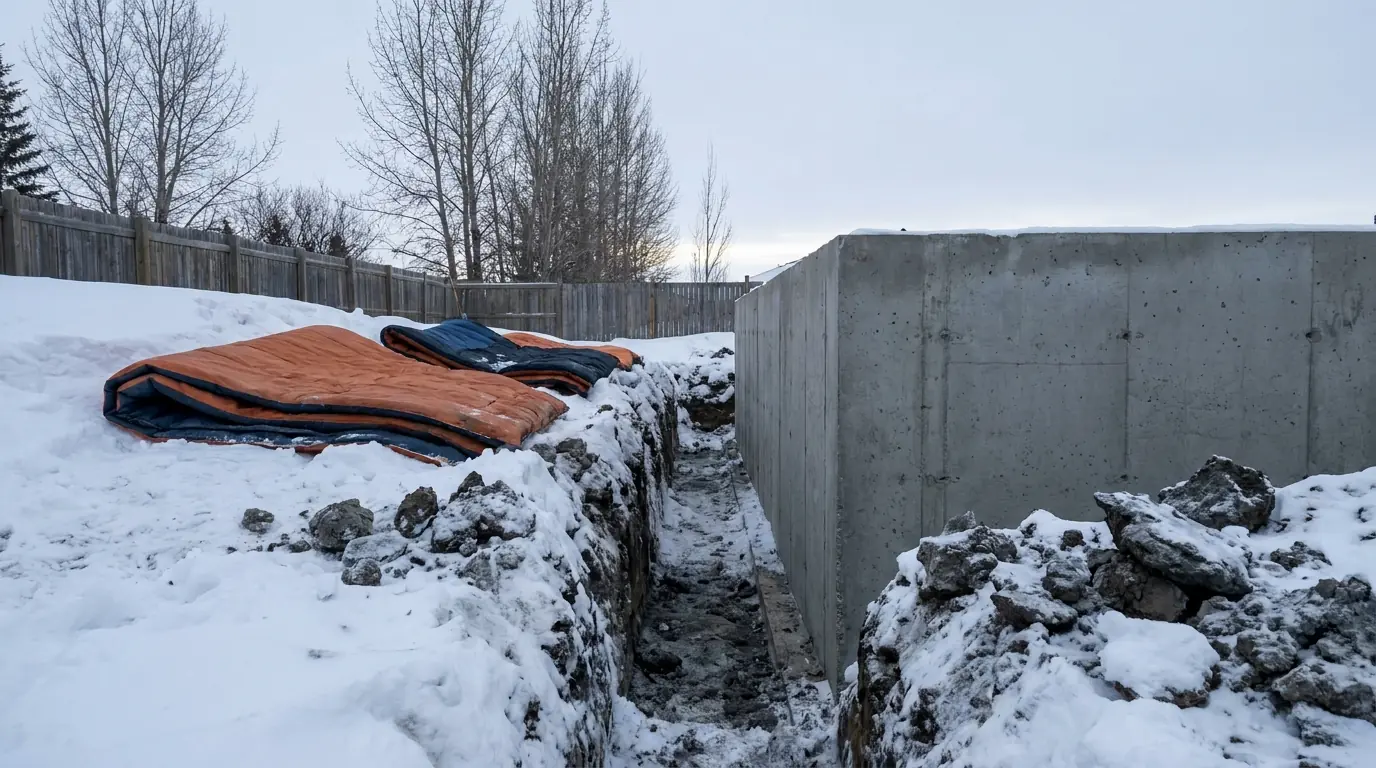
Can You Cut an Egress Window in a Calgary Winter?
Yes. The saw does not care what month it is.
That is the short answer, and it is worth stating plainly because a lot of homeowners are told to wait until spring by contractors who mean “I would rather do this in spring.” Those are different statements.
The longer answer is that winter changes several real things about this job, and being straight about them is more useful than either claiming winter is irrelevant or refusing the work.
Cutting concrete is not seasonal
Diamond wall sawing works on cold concrete the same way it works on warm concrete. The blade is cutting aggregate and steel, and neither behaves meaningfully differently at winter temperatures.
Concrete is also, if anything, slightly easier to cut cold than hot in terms of blade wear. This is not a selling point — it is a rounding error on the job — but it does dispose of the intuition that the cutting must be the seasonal part. It is not.
What is seasonal is everything that happens in the ground, and everything involving water.
Frost is a digging problem
The frost layer is the real difference, and it is a mechanical obstacle rather than a physical impossibility.
Frozen ground has to be broken through before ordinary excavation can start. Depending on the winter, the exposure of the wall and how much snow has been insulating the ground, that layer can be trivial or it can be the hardest part of the day. It takes more equipment, more time, or both.
On a machine-access site this is a manageable extra step. On a hand-dig — narrow lot, lane access only, fences and services in the way, which describes a great deal of the inner city — it is a substantially bigger deal, because breaking frozen ground by hand is genuinely slow work.
So the fair generalisation is: winter egress work is very doable, and it is more doable on a house where a machine can reach the wall.
The compensations are real
Two things get better in winter, and neither is marketing.
Frozen ground is firm ground. A wet spring excavation in Calgary clay can be a soup. The same site in February is stable, the excavation holds its shape better, and the mess tracked across your lawn and into the house is a fraction of what spring produces. On sloped or soft sites this can be the difference between a tidy job and a churned yard.
Schedules are open. Demand for this work follows the calendar even though the work does not. Winter is when a crew has room.
There is also a planning argument. If your basement is being finished in the spring, having the structural opening cut and inspected over the winter means the finishing trades are not waiting on a permit in April along with everybody else. The sequencing case is set out in how long an egress window takes.
What actually needs managing: water
Wall sawing is wet cutting. Water cools the blade and carries the slurry away, and in winter that water wants to freeze — on the wall, in the excavation, across whatever surface it runs over, and into a sheet of ice on the walkway somebody uses at seven in the morning.
Managing it is a matter of containment, collection and cleanup rather than anything exotic, but it is a genuine part of winter site discipline and it is a fair question to ask a contractor about. “What do you do with the slurry in January” separates crews that work through winter from crews that are trying it.
The other water question is sealing. Sealants, foams and membranes have manufacturer temperature ranges for application and cure. Working outside them produces a joint that looks finished and is not. Products rated for cold application exist and get used; the point is that the product has to be chosen for the conditions rather than pulled off the same shelf as in July.
The one risk that shows up in spring
Here is the winter-specific issue nobody mentions, and it is the reason to care about which contractor does the work rather than whether to do it in winter at all.
Backfill placed against frozen material, or backfill that itself contains frozen lumps, does not compact the way the same soil compacts in summer. When it thaws, those voids close, and the ground over your new excavation settles. Sometimes noticeably.
That produces two outcomes: a depression along the wall where you least want one, because water now runs toward the foundation rather than away from it; and a well that has moved slightly in ground that has moved around it.
None of that is a reason to avoid winter. It is a reason to expect the backfill and grading to be handled deliberately, and to expect a conversation about whether final grading and reinstatement happens now or after thaw. On a lot of winter jobs the honest answer is that the ground gets restored properly in spring, and the contract should say so rather than leaving you to discover it.
Ask. If the answer is that nothing is different, that is the wrong answer.
Where this does not apply
Deep excavations, stairwells and walk-out doorways are more exposed to the season than a window well is, simply because there is more ground involved and more of it is deep. A walk-out doorway in January is a bigger conversation than an egress window in January, and on some sites the recommendation genuinely is to wait.
And on any site, if the ground outside the wall is already saturated when it freezes, we would rather look at it before committing to a date.
The summary
The cutting is not seasonal. The digging is harder, the water needs managing, the sealants need choosing for the temperature, and the backfill needs thinking about twice. In exchange you get firm ground, less mess and an open schedule.
Send us the address and we will tell you whether your particular wall is a good winter job or a good spring one. Either answer is fine with us — see what actually moves the cost for what the season does and does not change about the number.
Need a foundation quote?
If you have a question about a foundation or want a quote, our team is ready to help. We serve Calgary and the surrounding communities.