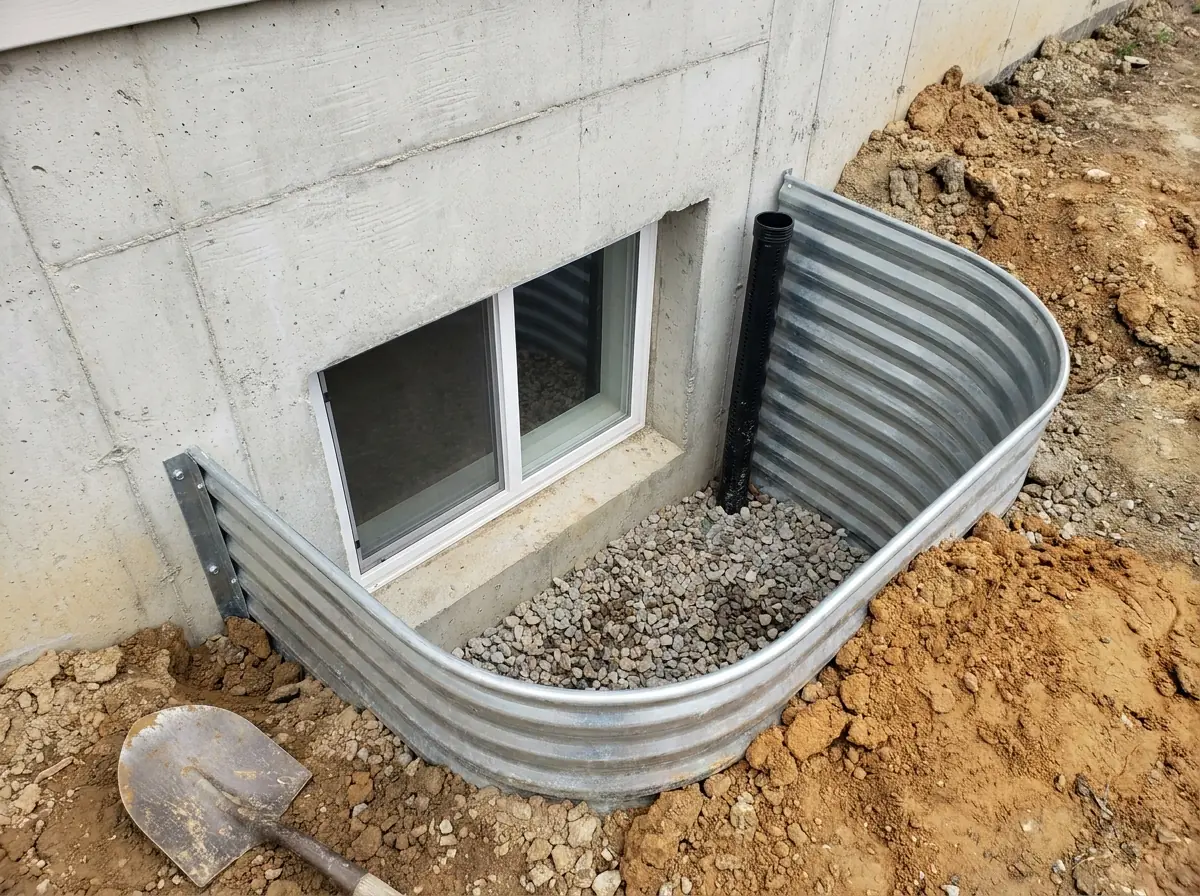
Window Well Size and Drainage in Calgary
Most people think of a window well as an accessory to the window. It is closer to the truth to think of it as two things the window cannot do without: a piece of the escape route, and a piece of the building’s drainage system.
Get either one wrong and the window above it stops being egress, or the basement below it stops being dry.
The dimensions that govern
Two figures from the building code apply directly to the well:
- Minimum clear projection: 760 mm
- A permanent ladder or steps is required where the well is deeper than 1.2 m
The word doing the work in the first one is clear. The 760 mm is space in front of the open sash — usable space, space a person can be in. It is not measured from the wall face and it is not the manufacturer’s stated well depth on the box.
The casement problem
This is the geometry that catches people, and it catches contractors too.
A casement window swings outward. That is why casements are so commonly specified for egress: swinging the whole sash out of the way gives the largest clear opening for a given hole in the concrete. But the sash has to go somewhere, and where it goes is into the well.
So a well sized at 760 mm from the wall face, with a casement swinging into it, does not have 760 mm of clear projection in front of the open sash. It has whatever is left. The window and the well were each specified correctly in isolation and the assembly fails.
The fix is not complicated — the well is sized with the swing accounted for from the start — but it has to be done at design, not discovered at inspection. If you are being quoted a well by depth and diameter with no discussion of which way the window opens, that is a question worth asking.
The ladder problem is the same problem
Past 1.2 m of depth, the well needs a permanent ladder or steps. That ladder cannot reduce the required clear projection.
Which means a deep well cannot be built to the minimum and then have a ladder added to it. The ladder occupies space. The well has to be dug wide enough that 760 mm of clear projection survives after the ladder is in it — and, if the window swings out, after the sash is in it too.
Deep wells are common in Calgary, because a lot of basements sit well below grade and because lowering a sill to meet the 1.5 m maximum sill height frequently pushes the bottom of the opening further down than the original builder ever intended. Depth is not a defect. It just changes what the well has to be.
Drainage: the part that decides whether you regret it
A window well is a hole in the ground next to your foundation with a window at the bottom of it. Every drop of rain and every centimetre of snowmelt that lands in it has to go somewhere.
If the answer is “into the soil at the bottom,” you need that soil to actually take it. Across large parts of Calgary — particularly through the north and east — the native ground is a glaciolacustrine clay that does not drain quickly. Water that arrives faster than the clay accepts it does not disappear. It sits in the well, against the wall, against the window, at the exact point where you have just cut a new penetration through the foundation.
There are two honest answers to that, and which one applies depends on the house.
Tie into the weeping tile. Where there is a functioning perimeter drain at footing level and it can be reached and connected to properly, the well drains into the system the house already has for exactly this purpose. This is usually the better answer and it is usually the more expensive one, because reaching footing level is a deeper excavation.
Build a drainage rock sump. A properly sized and properly separated body of drainage rock below the well gives the water somewhere to go while it waits for the ground to take it. Sized correctly for the catchment and detailed so that fines do not migrate in and clog it, this works. Sized by eye — a bag of gravel tipped in the bottom — it works for a season or two and then does not.
What we will not tell you from a web page is which one your house needs, or how deep, or how much rock. That comes from what we find when we open the ground.
Freeze-thaw is the Calgary-specific part
Water that sits in a well in November is ice in December.
Ice in a well expands, and it expands against the well liner, against the backfill, and against the window itself. Over a few winters an undrained well can distort a corrugated liner, pull backfill away from the wall, and load a window frame in a direction it was never designed for.
The chinook cycle makes this worse rather than better. Repeated melting and refreezing across a single winter puts a well through many more cycles than a colder, more stable climate would. A well that drains does not accumulate the water that does this. A well that does not drain, does.
This is the practical reason we treat drainage as part of the egress job rather than as an upsell. It is not a comfort item.
Liners, and what the choice actually changes
Galvanized corrugated liners, precast concrete, poured concrete and engineered retaining systems all appear on Calgary houses.
The honest summary: corrugated steel is the common, economical answer for ordinary depths and it works when it is backfilled and drained properly. Deeper wells, wider wells, wells that have to retain a driveway or a walkway edge, and anything that starts behaving like a stairwell rather than a well move toward concrete and toward engineered retaining design. The deeper and wider the hole, the more the soil pushing on it stops being a detail.
We cover the covers — grates, lids, and the rule that they must not defeat the egress — in window well covers and code.
Where this fits
Wells are half of the wells and stairwells service, and they are the half of an egress job most likely to be quoted thinly. If you are comparing quotes, the drainage detail is the line to interrogate — see what moves the cost.
Send us the address and we will tell you what the ground outside that wall is likely to do.
Need a foundation quote?
If you have a question about a foundation or want a quote, our team is ready to help. We serve Calgary and the surrounding communities.