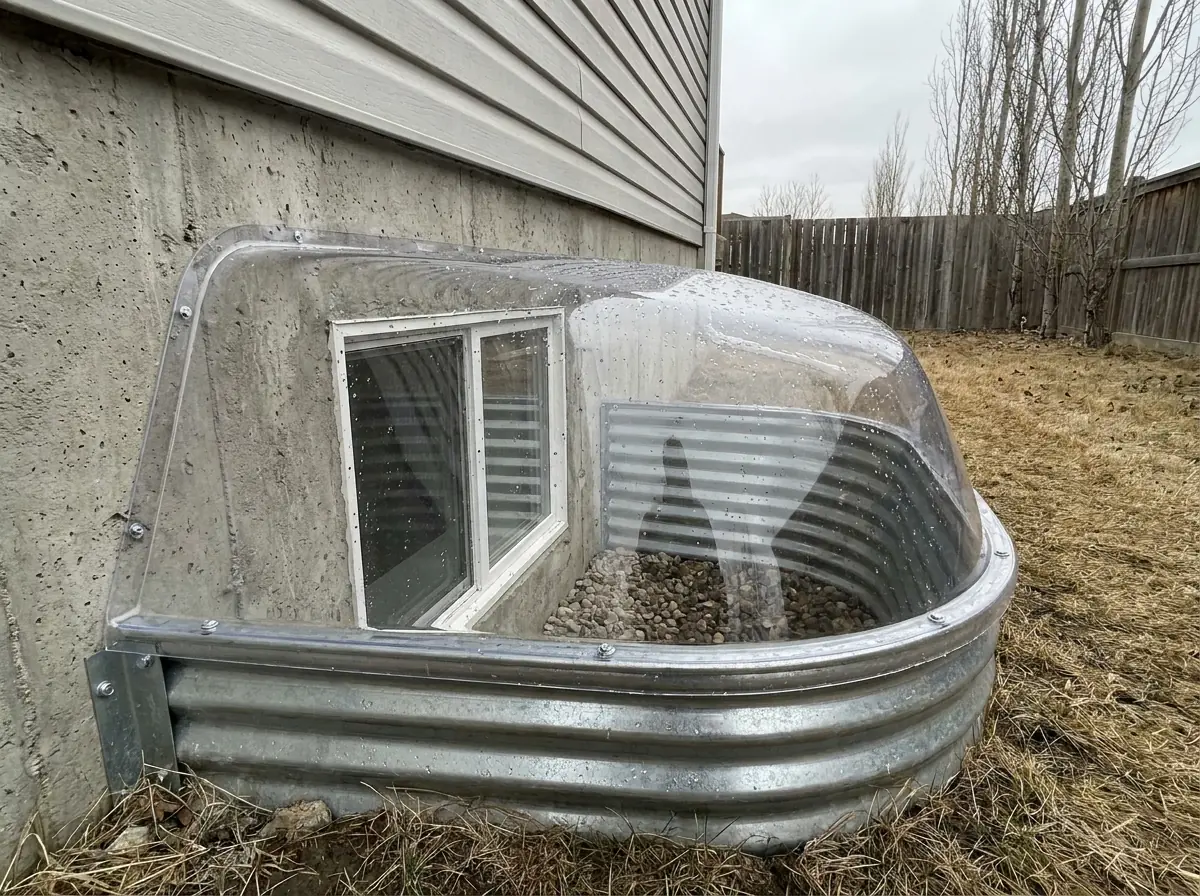
Window Well Covers and Code: What a Cover Must Not Do
Covers are not prohibited. People assume they are, because the requirement is about the escape route and a lid over the escape route sounds like an obstruction.
The correct framing is narrower and more useful: a cover is fine as long as it does not defeat the thing the well exists for. Getting that right is mostly a matter of understanding one phrase.
The phrase that governs
The egress window has to be openable from the inside without tools and without special knowledge.
Read that as applying to the whole escape route, not just to the window latch. An opening you can open, into a well you cannot get out of, is not a way out. A person going through that window in the dark, in smoke, possibly a child, possibly half asleep, has to be able to complete the journey.
Two separate tests live in that phrase, and covers tend to pass the first and fail the second.
Without tools is the obvious one. No screwdriver, no key, no wrench. A cover held down with fasteners fails immediately and nobody argues about it.
Without special knowledge is the one people miss. It means the way out cannot depend on knowing a trick. A latch that has to be released in a particular order. A panel that only lifts if you slide it first. A cover with a catch on the outside that you have to reach through a gap to find. A locking mechanism whose key lives upstairs. Each of those is operable without tools, and each of them fails, because operating it correctly requires having been told how.
The test worth applying at home: could a houseguest who has never been in your basement, in the dark, with no instructions, get out? If the honest answer is “once I’d shown them”, the cover is wrong.
What a cover is legitimately for
Three real jobs, all of them worth doing.
Keeping people and animals out of the hole. A deep well beside a walkway is a fall hazard and a trap for cats, rabbits and the occasional child.
Keeping debris out. Leaves, grass clippings and windblown litter accumulate in an uncovered well and end up in the drainage, which is the one part of the well you cannot afford to clog. See window well size and drainage for why that matters more in Calgary clay than people expect.
Keeping snow out. This is the local one, and it is the strongest argument for a cover here.
Snow, which is the Calgary-specific problem
An open well in Calgary fills with snow. Not gradually and evenly — it drifts, because a well is a hole in a wind field, and it can pack.
Packed snow in a well does two things. It obstructs the escape route at the exact moment escape routes matter, since heating season and fire season are the same season. And it becomes water when a chinook arrives, and that water is sitting against your foundation and your new window, and then it freezes again that night.
A cover that keeps snow out of the well is doing genuine work. A cover that holds snow on top of the well is doing a different thing, and that is where the second-order question comes in.
What we will not tell you about covers
We will not tell you what load a cover has to carry, in any units.
Covers are engineered products and their manufacturers publish ratings. Those ratings are theirs and they are specific to the product, its span, its support and how it is installed. A contractor’s blog stating a load figure is manufacturing a number, and on the specific question of whether the thing over your escape route will hold a snow load, a manufactured number is not a harmless one.
Ask the manufacturer, and read the installation instructions rather than the brochure. If a cover is being included in a quote, ask which product and ask to see its literature.
Similarly, we will not state grate spacing, bar dimensions or clearance allowances. The requirements we publish are the five figures in the building code and nothing else.
The interaction people forget
The well needs 760 mm of clear projection. A cover must not reduce it.
That sounds trivial until you consider how covers are mounted. A frame that sits inside the well rather than over it, a hinge assembly that intrudes, a support bar running across the middle — each of these takes space out of the volume the projection requirement is protecting.
And where the well is deeper than 1.2 m, there is already a permanent ladder or steps in it, which also must not reduce that projection. Add a cover with an intruding frame to a well that was sized tightly around a ladder and the arithmetic stops working.
The order to do this in is: size the well for the projection with the sash swing and the ladder accounted for, then choose a cover that sits over the top of all of it. Not the other way round.
Practical guidance
Pick a cover that lifts or pushes open from below with a shove, with no latch, no fastener and no sequence. Confirm it does not intrude into the well. Confirm its snow rating with the manufacturer for the way it is being installed. And check it in February — go down, open the window, and push. That is the only test that means anything, and it takes a minute.
If you have a cover you are not sure about, we look at covers as part of any well assessment. That work sits under wells and stairwells, and the compliance context is in the Calgary secondary suite egress rules.
Send us the address if you would rather have somebody else make the call.
Need a foundation quote?
If you have a question about a foundation or want a quote, our team is ready to help. We serve Calgary and the surrounding communities.