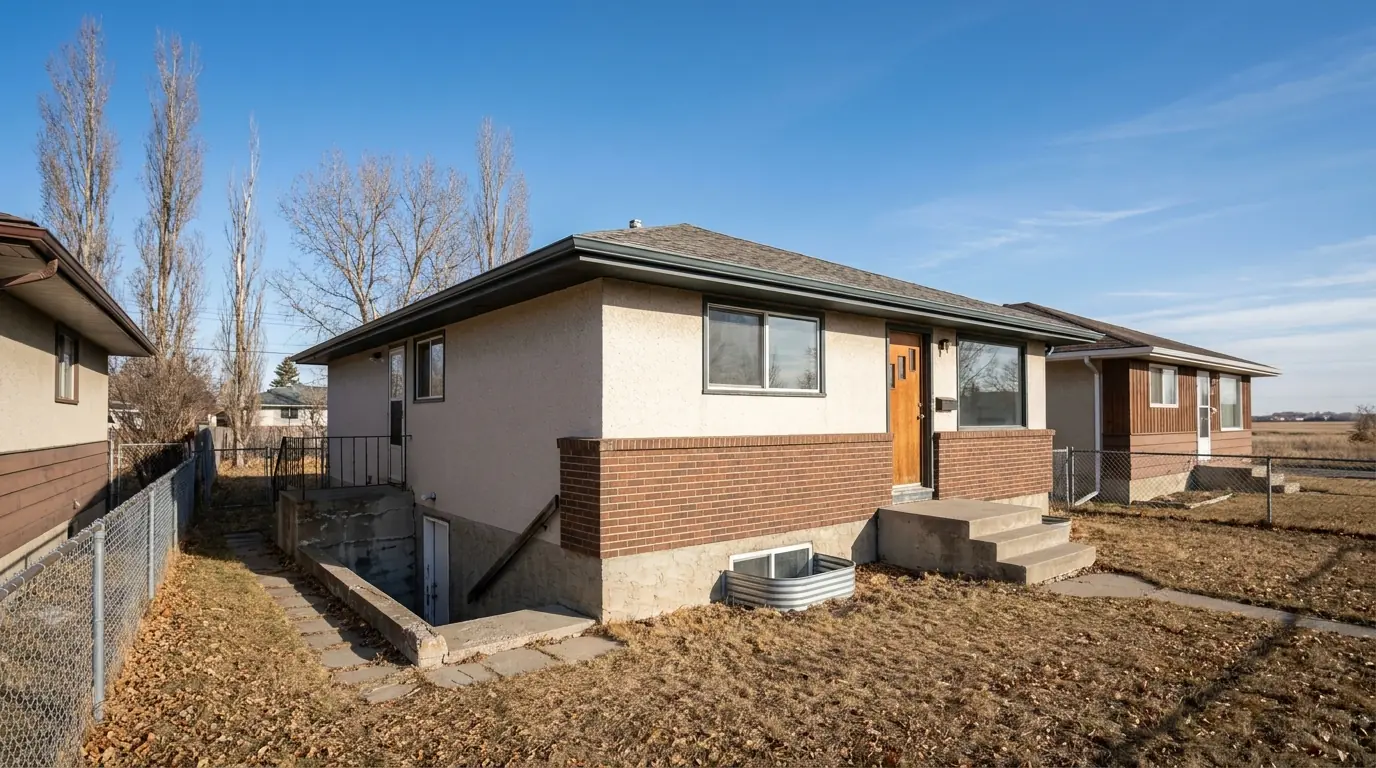
Selling a House With an Illegal Basement Suite in Calgary
First, the terms. “Illegal suite” is what everyone says; what is usually meant is a suite that was built without permits, or that does not meet current requirements, or both. Those are different situations with different fixes, and the first useful thing is to work out which one you have.
Second, the disclaimer, and we mean it. We are a contractor. What you must disclose, how a purchase contract should be worded, and what a listing may say are questions for your lawyer and your real estate agent, not for us. Nothing here is legal advice and none of it substitutes for asking those two people directly, early.
What we can talk about is the part that involves concrete.
Why the suite is worth less than you think it is
A secondary suite adds value to a house in a fairly direct way: it produces income, and income can be financed against.
Both of those depend on the suite being something a third party will acknowledge. A lender assessing whether rental income can support a mortgage, an insurer pricing a policy, an appraiser deciding what the property is — each of them is deciding whether to treat the basement as a suite or as a finished basement.
So the value of a suite to a buyer is not what it collects in rent today. It is what can be demonstrated about it. A suite that cannot be demonstrated is finished square footage with a second kitchen in it — worth something, but not worth what the owner has in their head.
That is the gap the whole transaction ends up negotiating over.
Three buyers, three reactions
In practice the market sorts itself into three responses, and it is worth knowing which one you are hoping for.
The buyer who wanted a legal suite. They are buying income and they have run the numbers on it. When the permit history does not support the suite, this buyer either walks or reprices to the cost of making it right — plus a margin for the risk of what they cannot see. They will not pay you for the suite, because from their side they have not yet bought one.
The buyer who wanted a big house. They see a finished basement and a spare kitchen. They may be perfectly happy. They will not pay a suite premium either, because they were never buying a suite. This is a fine outcome; it is just not the outcome the seller was pricing for.
The buyer who intends to rent it anyway. They exist, they know exactly what they are buying, and they are the most likely to discount hard, because they are consciously taking on the risk you are trying to hand over.
Notice that in all three cases the seller does not get paid for the suite. The premium is available only when the suite can be shown to be what it claims to be. That is the actual economic argument for fixing it before listing rather than after an offer.
Where egress sits in the list
Suites fail for a lot of reasons — separations, alarms, ceiling heights, ventilation, ceiling assemblies, parking, land use. We are not going to enumerate what the City of Calgary will look at or what your particular suite needs; that is for the authority having jurisdiction to determine and for somebody who has been inside it to assess.
But egress has a specific character among that list: it is the item that cannot be fixed with finishing trades.
Everything else on a typical deficiency list is drywall, wiring, doors, detectors, sealing, labour. Egress is a structural opening cut into a foundation wall, with a lintel, engineering, a permit and a drained well. It has the longest lead time and it is the one that has to happen first, because you cannot frame a bedroom around a window that has not been cut.
Which is why, when a seller asks us what to do first, the answer is almost always: find out about the window before you plan anything else. The bedroom either satisfies 0.35 m² (3.77 sq ft) of clear opening, the 380 mm (15”) minimum dimension and the 1.5 m maximum sill height above finished floor, or it does not, and that answer reorganises the entire project. The details are in the Calgary secondary suite egress rules.
The three options, honestly
Bring it into compliance before listing. Best outcome, longest runway. Requires the structural work to be sequenced ahead of everything else — see how long an egress window takes — and requires you to start well before you want a sign in the yard.
Sell it as what it is. Take the discount, describe the property accurately in whatever terms your agent and lawyer advise, and let the buyer price the risk. This is a legitimate choice, particularly if you need to move on a fixed date.
Remove the suite. Sometimes the cleanest answer for a house that was never well suited to one. Pulling the second kitchen and selling a large finished basement is occasionally worth more, and worth less trouble, than a suite that will never quite work.
What is not an option is describing the property as something it cannot be shown to be. That is exactly the ground where a transaction goes badly wrong later, and it is the reason the lawyer conversation comes first.
The mid-transaction version
If you are already under contract and a condition has surfaced the problem, the position is worse but not hopeless.
The thing to establish quickly is scope: is the egress opening the problem, or is egress one item on a longer list. Those lead to very different conversations with a buyer. A single structural opening with a defined scope is something a price adjustment or a holdback can be built around. An open-ended list is not.
We will look at a wall on that timeline and tell you what the opening involves, including when the answer is that it is not straightforward. What we will not do is give you a date by which a municipality will act, because we do not control that and neither does anybody quoting you.
Start with the wall
Suite compliance is the service; the engineering and permit file is the part most sellers want off their desk; and what actually moves the cost explains why the quotes you collect will differ.
Send us the address, ideally before the listing appointment rather than after the offer.
Need a foundation quote?
If you have a question about a foundation or want a quote, our team is ready to help. We serve Calgary and the surrounding communities.