Egress Window Cost in Calgary: What Actually Moves the Number
There is no price in this article.
That is not coyness. It is that we have not published a verified range, and a made-up one would do you active harm: you would carry it into three conversations, use it to judge three quotes, and it would be wrong in a direction you could not detect.
What we can do — what is actually more useful — is tell you what the number is made of, so that when three quotes land in your inbox you can work out why they disagree.
The single biggest variable is the wall, and nobody can see it over the phone
An egress window is a structural opening cut into a foundation. What that costs is governed by what the foundation is.
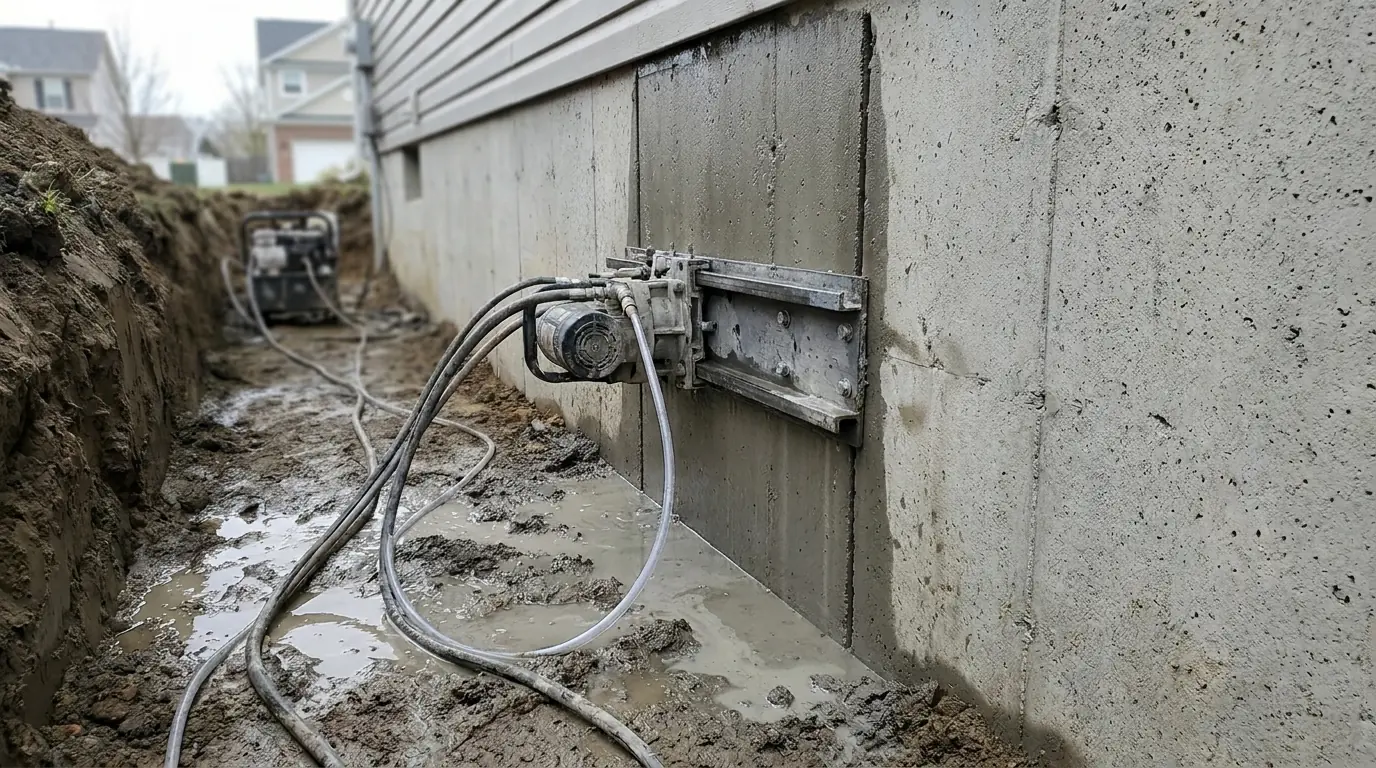
A poured, reinforced wall in a 2004 suburban house and an unreinforced wall in a 1948 bungalow are not the same job with a different sticker. They are different sequences of work. Reinforcement changes blade consumption and cutting time. Wall thickness changes it again. A concrete block wall is a different structural problem entirely, because the load path over a new opening does not behave the way it does in poured concrete — that gets its own article, block versus poured.
Anyone who gives you a firm number before knowing which of those you have is either quoting a scope that will change, or quoting high enough to cover the worst case. Both are rational. Neither is information.
The second thing nobody can see over the phone is the ground outside the wall. Whether a machine can reach the excavation, or whether it is a hand-dig down a lane past a fence and a gas line, is frequently a larger swing than the concrete work itself. In the older inner-city communities — Altadore, Killarney, Bankview, Inglewood — hand-digging is common enough that it should be assumed until proven otherwise.
Why the cheap quote and the expensive quote are usually pricing different jobs
When two quotes for the same house are far apart, the usual explanation is not that one company is greedy and the other is generous. It is that they have drawn the boundary of the job in different places.
Here are the five places that boundary commonly moves.
Drainage. The excavation has to go somewhere with the water it will collect. Tying the well into weeping tile, or building a properly sized drainage rock sump, is real work with real material. A quote that treats the well as a metal liner set in native soil is cheaper than one that treats it as part of the building’s drainage system, and it is cheaper because it is less.
Engineering. Removing a section of a load-bearing wall and spanning the gap is a structural alteration. Where a stamped drawing or a letter of assurance from an APEGA-licensed P.Eng. is required, that is a line item. Some quotes carry it, some assume you will arrange it, some are silent and you find out later.
Permits. Permits are pulled from the City of Calgary, or from the relevant municipality if you are in Airdrie, Okotoks or Cochrane. Whether the contractor applies on your behalf or hands you the file is a scope difference, not a quality difference — but it is not free either way.
Landscaping reinstatement. The excavation destroys whatever was there. Sod, a paver walk, a fence panel, an irrigation line, a shrub bed. “Backfilled and rough graded” and “restored to the condition we found it in” are separated by a meaningful amount of money, and the two phrases can sit in quotes that otherwise look identical.
Spoil removal. Cutting a window generates soil and concrete. Somebody either hauls it away or leaves it in a pile on your lawn. Disposal has a cost, and it is one of the easiest things to quietly omit.
None of these are exotic. All five are routinely left ambiguous.
The questions that make quotes comparable
If you do nothing else with this page, take these into the conversation. They are ordered roughly by how much money hides behind them.
- What do you believe my foundation wall is, and how will you confirm it before you commit to this price?
- Is the excavation machine-access or hand-dig, and what happens to the price if that assessment turns out to be wrong?
- Does this include engineering, and if so whose stamp?
- Who applies for the permit, and is the application cost inside this figure?
- What is the drainage detail — is the well tied into weeping tile, or into a rock sump, or neither?
- Where does the spoil go?
- What condition is the ground left in, in writing?
- Is the window itself in this number, and which one?
A contractor who answers all eight without hesitating has thought about your house. A contractor who cannot answer number one has not been to it.
What does not move the price as much as people expect
Two things get over-weighted in most conversations.
The window unit itself is rarely the deciding factor. It matters, and a casement, slider or hopper of the same rough opening give different clear openings — see the size requirements for why that is a compliance question before it is a cost one. But the unit is usually a minority of the total. The cutting, the lintel, the excavation and the drainage are the job.
Time of year matters less than people assume for the cutting and more than they assume for the digging. That is its own article, and the summary is that winter is not the barrier it is treated as.
When the honest answer is “don’t”
Sometimes the scope that comes back is larger than the outcome justifies.
If the basement will never be a bedroom, will never be rented, and will never be sold as finished space, an egress window is a nice-to-have with a structural price tag. If the wall in question is holding something unusual up — a cantilevered second storey, a chimney mass, a beam pocket in the wrong place — the engineering may point you at a different wall, a different room, or a different plan entirely.
We would rather tell you that at the site visit than after the saw is on the truck.
Getting a number for your actual house
The only quote worth anything is one written after somebody has looked at the wall, the grade outside it, the access route and what is above the cut line.
That is what our site visit is for, and it is what the cost page sets out in more detail. The scope itself is described on the egress window installation page. Bring the eight questions. Ask them of us too.
Need a foundation quote?
If you have a question about a foundation or want a quote, our team is ready to help. We serve Calgary and the surrounding communities.